 EN
EN  PT_BR
PT_BR The new executive director of the Round Table on Responsible Soy Association (RTRS), Marina Muscolo, made her first official visit to Brazil in October with the aim of strengthening dialogue with local partners, learning firsthand about the implementation of the RTRS Standard in the field, and visiting social projects associated with the certification.
The agenda began in São Paulo with a working meeting with Rabobank's Head of Sustainability, Taciano Custódio, with whom he discussed the role of financing in promoting sustainable soy production.

RTRS Executive Director, Marina Muscolo: “Being present on certified farms and associated social projects has allowed me to learn about advancements, exchange experiences, and learn from local producers and partners.”
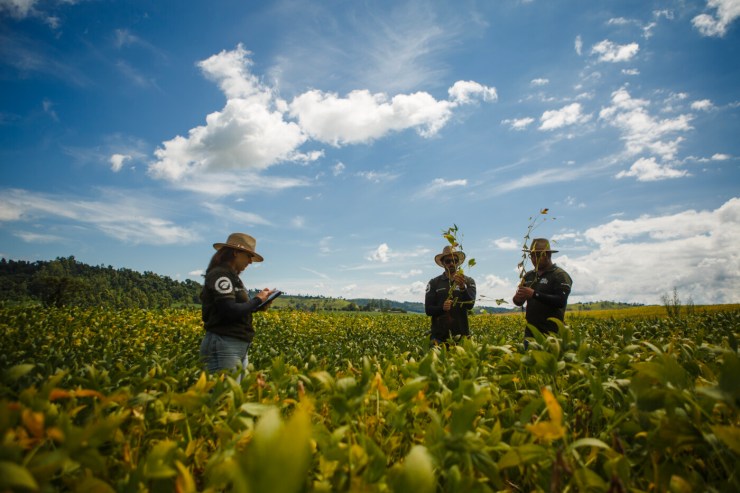
Next, Marina visited Amaggi's headquarters in Cuiabá (MT), accompanied by the company's Head of Sustainability, Fabiana Reguero. In the region, she had the opportunity to visit the Santa Ernestina Farm in Sorriso (MT), an RTRS-certified farm that is part of the certification group managed by CAT Sorriso. During the visit, she also learned about the social projects led by the association, under the coordination of Cristina Delicato, which develop actions with a positive impact on the local community.
In Sinop (MT), the director of RTRS visited Embrapa Agrossilvipastoril, where she learned about the results of the unit's main research project. The study analyzes the differences in gas emissions over 14 years of production in different management systems: agriculture-livestock, agriculture-forestry, livestock-forestry, and agriculture-livestock-forestry, as well as each management system in isolation.
The research considers all emissions and gas sequestration, both from agricultural operations and the soil, offering a complete view of the environmental impact of each system. “The visit with the RTRS team was a productive meeting, fostering integration and exchange of experiences. We visited an RTRS-certified farm, saw one of the restored springs of the Lira River, held an alignment meeting at the institution's headquarters, and ended the day at Embrapa Agrossilvipastoril, one of the world's leading centers for research and innovation in regenerative agriculture. It was an opportunity to reinforce our commitment to increasingly responsible and sustainable production,” says Cristina Delicato.
In Brasília (DF), Marina met with the representative of WWF Brazil, Jean François Timmers, who was previously a member of the RTRS board, to discuss environmental conservation and sustainability strategies in the context of responsible soy production. The conversation provided an in-depth look at the role of certification in addressing sustainability challenges and controlling deforestation in Brazil.
Matobiba
The visit continued to Balsas (MA), where Marina participated in the 32nd Ordinary General Assembly of the Foundation for Research Support of the Northern Export Corridor (Fapcen). The event reinforced the importance of integration between research, partnerships, and purpose, highlighting the Foundation's role as a benchmark in innovation, sustainability, and agricultural development in Maranhão and throughout the Northern Corridor. On that occasion, Fapcen reported on its projects, the Agrobalsas project, and the RTRS certification to its members.

Marina Muscolo made her first official visit to Brazil in October with the aim of strengthening dialogue with local partners.
The following day, Marina departed for the state of Piauí, accompanied by the superintendent of Fapcen, Gisela Introvini, and her team to visit Fazenda Progresso, one of the RTRS-certified properties through the Foundation. “The visit from the RTRS team, especially its director, was an opportunity to learn in detail about Fapcen's work in the region and how RTRS certification has transformed the reality of the communities. We celebrate the realization of this type of meeting and reinforce our commitment to giving visibility to the efforts and dedication of the producers,” highlights Gisela Introvini.
Welcomed by the owner of Grupo Progresso, Cornélio Sanders, and the communication and sustainability team, Marina toured the farm facilities and learned about one of the largest social projects under construction, developed with resources from the RTRS certification: the Integrated Center for Human Development, located in Bertolínia (PI).
The center is an initiative of the Cultivar Progresso Institute and will benefit more than 28,000 people, offering health and physiotherapy services, support for children with special needs, occupational therapies, and an early childhood education center serving five neighboring municipalities. The project is funded with resources from Fapcen, generated by RTRS certification credits, in conjunction with contributions from the Cultivar Progresso Institute.
The visit reinforces RTRS's commitment to responsible soy production. "Being present on certified farms and associated social projects allowed me to learn about advancements, exchange experiences, and learn from local producers and partners, as well as strengthen strategic alliances that are fundamental to the growth of an increasingly responsible and sustainable sector," says the RTRS executive director.