 EN
EN  PT_BR
PT_BR 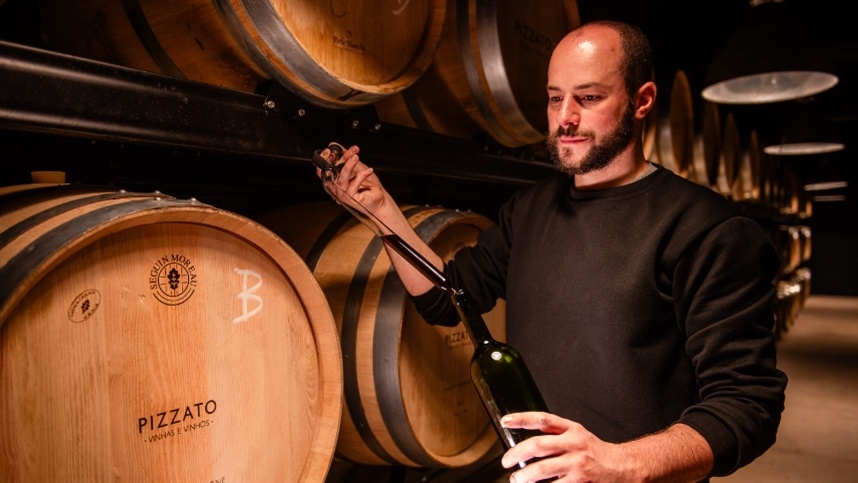
Before reaching the glasses of the National Wine Evaluation, the wines of the 2026 vintage are being collected precisely where they are still resting and evolving. Since August 3rd, approximately 30 enologists invited by the Brazilian Association of Enology (ABE) have been traveling through different wine-producing regions of the country to collect, directly from the wineries, the 569 samples registered for the 34th National Wine Evaluation – 2026 Vintage.
The operation involves 84 wineries from 10 Brazilian states – Bahia, Espírito Santo, Goiás, Minas Gerais, Pernambuco, Paraná, Rio de Janeiro, Rio Grande do Sul, Santa Catarina and São Paulo – as well as the Federal District, and will continue until August 24th. Throughout these 16 days of collection, ABE professionals visit the production units and find wines at different stages of their production: in stainless steel tanks, concrete eggs, oak barrels, or already bottled. It is from there, before commercial bottling, that the samples are taken to Bento Gonçalves (RS) and will enter the technical evaluation process.
The procedure is one of the cornerstones of the credibility built by the National Wine Evaluation. Instead of receiving pre-selected bottles from companies and sending them to the competition, ABE assumes responsibility for collecting the samples at their origin. All samples follow the same protocol for collection, identification, transport, and storage, preserving traceability and equal conditions from the beginning of the process.
Visiting the wineries also allows one to see, even before tasting, some of the diversity that characterizes contemporary Brazilian wine production. Different regions, varieties, climatic conditions, production scales, and winemaking choices are represented in the 569 samples. The presence of wines stored not only in traditional stainless steel tanks and barrels, but also in concrete eggs, is a reflection of the different techniques and winemaking methods adopted today by Brazilian wineries.
“When our team enters the winery and collects the wine directly from the container where it is being made, the evaluation process effectively begins. It is a huge responsibility because we are dealing with 569 samples that represent the work of producers and winemakers from different regions of Brazil. All this care exists to ensure that what reaches the tasting is exactly the wine submitted by each company,” emphasizes the president of ABE, winemaker Mário Lucas Ieggli.
Selection Tasting
After being collected, identified, and gathered in Bento Gonçalves, the samples proceed to one of the most important stages of the evaluation: the Selection Tasting. It is at this point that the entire 2026 vintage wine collection will undergo a blind sensory analysis by 108 enologists divided into 12 groups. The Selection Tasting will take place from September 1st to 4th at the Bento Gonçalves Business Center. During these days, the process that will define the 30% wines most representative of each category will take place.
Among them will be the 16 wines that will be tasted by the public on October 17th, during the 34th National Wine Evaluation – 2026 Vintage, in Bento Gonçalves. Until then, however, there is a long technical journey. And it begins within the wineries, when a bottle, still without a label, receives only a code and comes to represent, under the care of ABE (Brazilian Association of Enology), a small part of the Brazilian 2026 Vintage.
Meanwhile, the public secures a place in the Evaluation.
With the collection underway, wine lovers from different regions of Brazil are also mobilizing to participate in this great moment for Brazilian wine. Tickets for the 34th National Wine Evaluation, which will be held on October 17th in Bento Gonçalves (RS), are on sale. There are 800 places available to watch the simultaneous tasting of 16 representative samples from the 2026 vintage, chosen after the entire technical selection process conducted by ABE. Tickets can be purchased through the website www.enologia.org.br.