 EN
EN  PT_BR
PT_BR 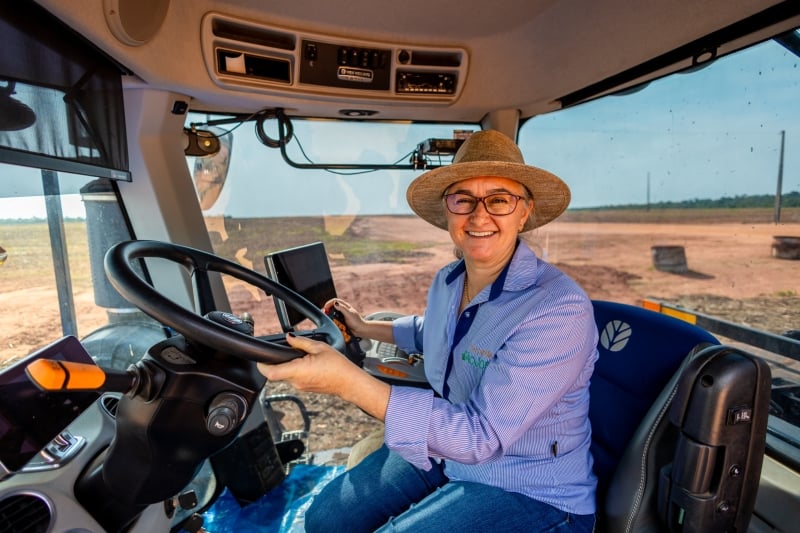
Three women, three journeys, one shared home. In the heart of Brazil, where the countryside pulsates with life and hope, Elaine, Bruna, and Mariana represent stories that complement each other and paths that intertwine through their love of the land. On Rural Women's Day, the Mato Grosso Soybean and Corn Producers Association (Aprosoja MT) celebrates their stories of courage, resilience, and dedication. Women who are transforming Mato Grosso's agriculture with sensitivity and strength.
Elaine Terezinha Corassa Botton arrived in Mato Grosso with a heart full of dreams and a baggage laden with courage. Coming from the interior of Rio Grande do Sul in 1994, she faced the unknown in search of a new life in Jaciara. The beginning was marked by challenges: a different climate, demanding soil, distance from family. But her will to succeed was greater. In 2006, they moved to Lucas do Rio Verde and, with hard work, sleepless nights, and faith in the future, she helped build what is now a productive property full of history.
“We faced several difficulties. The first, as a woman, was being far from my family. Down South, we lived very close to each other, and the first culture shock was this: the isolation. I learned to drive and started to manage the business as well. Gradually, as the farm grew, the need arose to pay bills, run errands, and pick up parts in Rondonópolis. The distance was great, the traffic was heavy, and that's how I started to participate more in the farm's operations outside the gate,” Elaine recounts.
At 55, she proudly recounts what she has faced with her husband and children, the satisfaction of doing what she loves, and reflects on the role of women in agriculture. “Certainly, I am proud to be a rural woman because I do what I love, and I believe that, as women, we must have courage, dedication, perseverance, and belief. Today, women have a very important role. If they want to participate, they can, even in a decisive way. It helps a lot because men need support too. A woman doesn't need to stop being feminine to participate in agricultural activities,” concludes the producer.
Like Elaine, Bruna Soares Alves dos Santos learned about farming in the countryside. Before moving to the municipality of Sorriso to join her husband in his business, she lived in the city and knew nothing about agriculture. Eager to learn more, she began by counting cargo manifests, controlling diesel fuel consumption, helping in the canteen, taking care of the house, and, over time, learned more about administration, discovering that caring for the crops required the same dedication she already had in caring for her family.
“With two small children, in an unfamiliar world, I didn’t understand the care that farming required, and I learned that it’s like taking care of a family: it demands dedication and constant attention. Today, after so many years, I have learned and developed this love for production. Aprosoja MT has also given great support to producers and space for us women, which is very important,” says the producer.
Today, at 35, she reinforces the pride she has in being a rural producer. “What makes me most proud is knowing that we produce much more than food. We produce lives. Because all production is present in every aspect of human life, from medicines and food on the table to clothing. Knowing that, wherever we go in the world, the mark of the rural producer, both men and women, will be there,” declares Bruna.
Mariana do Valle Brizola Tomazoni, 36 years old, is originally from Goiás and has always been in contact with nature, but it was in 2008, when she came to Mato Grosso, that she began practicing agriculture. For her, planning and seeing the realization of her work is what inspires her.
“The greatest pride is reaping the rewards. Everything comes from planning. You plan from the purchase, the finalization of the package, the variety and the management. Then you plant, monitor the development and see the results. We face climatic challenges, and sometimes the prices don't help much. But we, as Brazilians, never give up. We have gratitude from one year to the next, and that motivates me to want to continue in this field,” explains the producer.
For her, being a rural woman means enjoying taking care of the details that make all the difference at the end of each harvest.
“The time when they said women couldn't be in the fields is over. That a woman's place is at home or in an office. It's very rewarding to be involved with the land. Today we see so many women in all areas of agriculture. A woman's place is wherever she feels good, wherever she enjoys what she's doing. To those who want to start, I say: in agriculture, you have to enjoy what you're doing, because it's not an easy job. You face sun, rain, and heat. So, you just have to want it and enjoy it,” concludes Mariana.
With pride and admiration, on this Rural Women's Day we celebrate all those who cultivate more than just food: they cultivate stories, values, and the future of our country.