 EN
EN  PT_BR
PT_BR Rain is beginning to move over Brazil's main producing regions and should create favorable conditions for the 2026/27 summer crop in early October. However, rainfall distribution remains uneven, with areas of Mato Grosso and MATOPIBA experiencing moisture deficits, according to remote sensing data from EarthDaily, a company that monitors agricultural areas using satellite imagery.
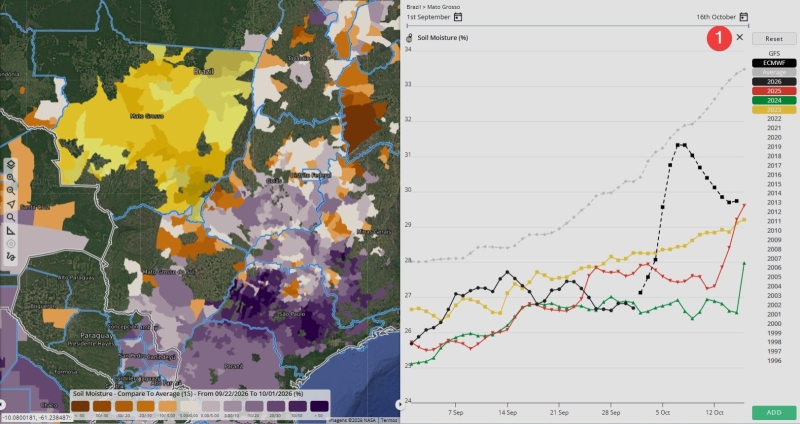
“Between September 22nd and October 1st, rainfall was recorded over much of the Central-South region of the country. In the Central-West, Mato Grosso do Sul and parts of Mato Grosso and Goiás recorded above-average volumes, favoring the recovery of soil moisture and the start of the soybean and summer corn harvest. Other areas of Mato Grosso and Goiás, however, received lower volumes, maintaining quite heterogeneous conditions,” explains Felippe Reis, crop analyst at EarthDaily.
This irregularity causes soil moisture recovery to occur at different rates within the same region. Mato Grosso remains one of the main areas of concern for planting progress, while Goiás and parts of Mato Grosso do Sul present more favorable conditions.
Mato Grosso may experience a rapid, but temporary, recovery.
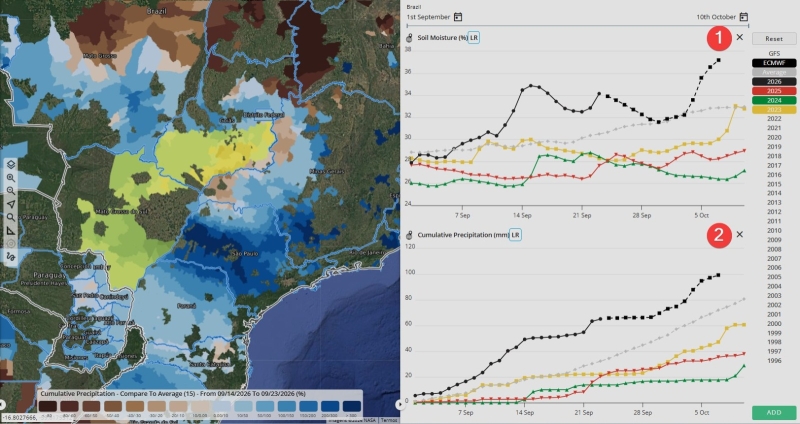
In Mato Grosso, despite recent rains, soil moisture remained below average for almost the entire month of September. However, for the beginning of October, the European climate model (ECMWF) indicates a rapid recovery, which could exceed 31%, approaching the historical average, before declining again in the following days.
This improvement would be important for planting and establishing the 2026/27 soybean crop. However, the projected drop later indicates that the situation may be temporary, maintaining the need for regular rainfall throughout October to support crop growth.
Rain favors summer harvest in the Midwest.
For the next ten days, ECMWF and GFS indicate above-average rainfall across much of the South-Central region, including important soybean and corn producing areas. This scenario is likely to create more favorable conditions for the advancement of the 2026/27 soybean planting in the Central-West region.
“The models, however, show important differences regarding temperatures. The ECMWF indicates temperatures near or below average in most producing regions, while the GFS projects more significant positive anomalies in the Midwest, especially in Mato Grosso,” comments Felippe Reis, crop analyst at EarthDaily.
This divergence is relevant for soybeans. In the milder ECMWF scenario, the lower evaporative demand would favor the use of predicted rainfall. Conversely, the warmer GFS scenario would increase water demand and could delay improvements in areas that still have a water deficit.
To October 7thThe ECMWF predicts a significant improvement in water conditions in the Midwest, mainly in Mato Grosso, Goiás, and Mato Grosso do Sul. If the projection is confirmed, the environment should become more favorable for planting and establishing the 2026/27 soybean crop.
MATOPIBA still depends on confirmation of rainfall.
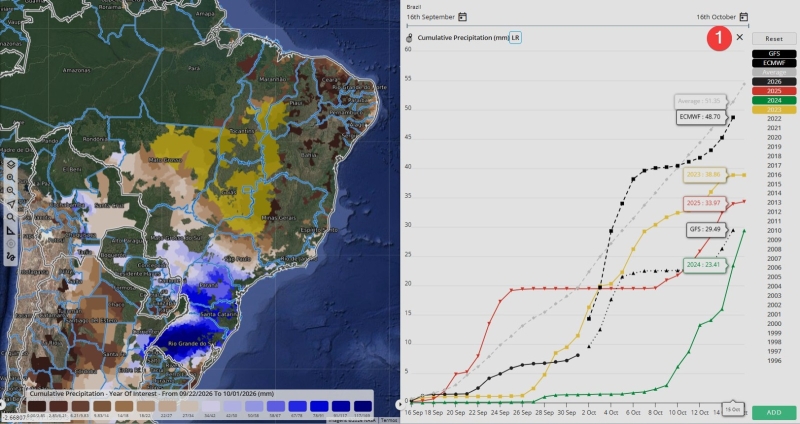
In MATOPIBA, accumulated rainfall since mid-September remains below the historical average, despite increased precipitation at the end of the month.
However, the scenario also varies between states: Maranhão and Piauí have areas with above-average rainfall, while Tocantins and Bahia are experiencing predominantly drier conditions than normal. Therefore, rainfall is not yet uniform across the region, increasing the need for further precipitation in the coming weeks as the summer crop planting progresses.
For the next two weeks, the models show strong divergence: the ECMWF projects an intensification of rainfall, with accumulated rainfall potentially reaching around 49 mm, close to the historical average of 51 mm, while the GFS predicts only around 29 mm.
For the 2026/27 soybean crop, confirmation of the wetter ECMWF scenario would favor soil moisture recovery and planting progress. Conversely, the drier GFS scenario could maintain water limitations in parts of MATOPIBA and restrict the planting pace.
High humidity benefits planting in the South.
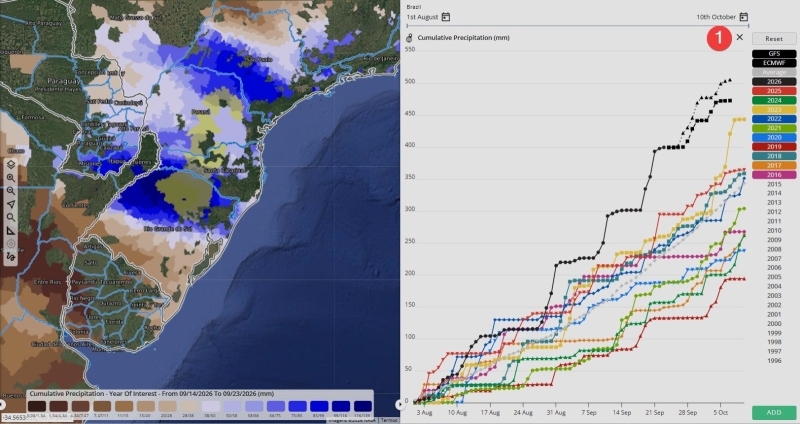
In the South, Paraná and parts of Rio Grande do Sul have above-average soil moisture. The high water availability favors the establishment of the summer crop, but for wheat, the persistence of very wet soils continues to be a risk factor, especially for crops in the maturation and harvesting stages.
Rainfall has intensified significantly in recent weeks, with high accumulations mainly in Paraná, Santa Catarina, and Rio Grande do Sul. The volume recorded since the beginning of August is already well above the historical average and, according to the ECMWF forecast, could approach 600 mm by mid-October, further increasing the excess compared to recent years.
About EarthDaily
EarthDaily Analytics is a global leader in Earth Observation, providing data and insights that empower industries and governments to make informed decisions for a more resilient future. With the launch of the groundbreaking EarthDaily Constellation, the company is revolutionizing how we monitor, understand, and interact with the planet.