 EN
EN  PT_BR
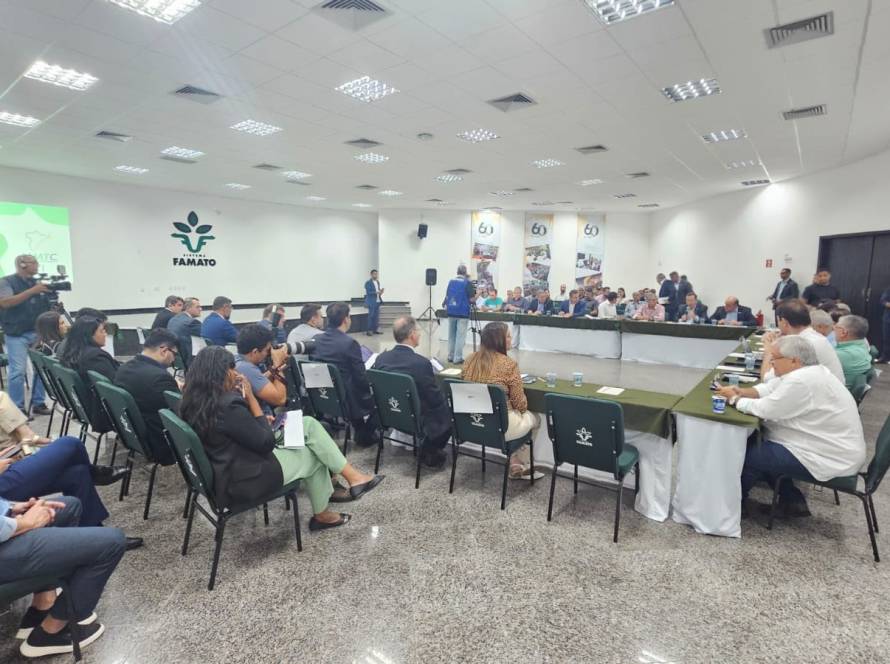
PT_BR A technical mission from France, with 20 representatives from the beef supply chain, visited the headquarters of the Mato Grosso Agriculture and Livestock Federation System (Sistema Famato) in Cuiabá on Thursday morning (October 30). The group, organized by the Association Nationale Interprofessionnelle du Bétail et des Viandes (Interbev), is seeking data on production, sustainability, prices, exports, imports, and logistical bottlenecks to develop a diagnosis of the sector in Brazil.
The agenda began in Cuiabá and will continue through other states, with visits to farms and meat processing plants. Participants include ranchers, leaders of associations and employers' unions, as well as owners of restaurants, butcher shops, and slaughterhouses from various regions of France. The objective is to understand, firsthand, the Brazilian model of meat production.
The superintendent of Famato and Imea, Cleiton Gauer, presented an overview of Mato Grosso's agribusiness, with an emphasis on beef cattle farming. According to him, Mato Grosso accounts for a significant portion of the country's beef production. The state's supply reaches 1.94 million tons, with 39,041 TP4T destined for direct export and 54,691 TP4T sent to other states. The domestic market absorbs 6,271 TP4T.
To put the scale into perspective, Gauer pointed out that Mato Grosso has over 903,000 km², an area larger than France and Germany combined. The low population density and long distances explain some of the challenges in transportation.
Giant in production
The strength of soybeans and corn sustains the protein chain. In the 2025/26 harvest, the supply of soybeans is estimated at 48.11 million tons, of which 60.97% are destined for export. The local industry processes 10.08 million tons of soybean meal and 2.62 million tons of soybean oil.
For corn, the projected supply for 2025/26 is 53.29 million tons, with 48.98% destined for export. Of the industrial consumption, 76.80% goes to corn ethanol and 23.20% to animal feed, which supplies poultry, swine, and cattle.
Regarding logistics, Cleiton highlighted that grain outflow through the Northern Arc increased from 14,571 TP4T in 2010 to 53,211 TP4T in 2024. For fresh beef, the Port of Santos leads in exports, followed by terminals in the North. The expansion of transport modes is seen as a chance to reduce costs and gain competitiveness.
The group asked questions about the livestock cycle, supply stability, and traceability. These points were addressed in the projections and indicators presented by Imea.