 EN
 PT_BR
According to the final survey of the Geographic Information Systems Project for Agribusiness in Mato Grosso do Sul (SIGA-MS), carried out by the Mato Grosso do Sul Soybean Producers Association (Aprosoja/MS) with resources from Fundems/Semadesc, the state's corn production in the 2025/2026 harvest reached 16.23 million tons, cultivated in 2.348 million hectares, with a weighted average productivity of 115.21 sacks per hectare.
"The numbers represent the best performance in the project's historical series, both in production and productivity," points out the technical coordinator of Aprosoja/MS, Gabriel Balta.
Compared to the 2024/2025 harvest, when 13.933 million tons were harvested, the volume produced increased by 16.51 TP4T. Productivity also improved, rising from 108.42 to 115.21 sacks per hectare.
"The result consolidates the importance of second-crop corn for agriculture in Mato Grosso do Sul, with differences in performance between producing regions and a significant contribution from municipalities that concentrate large cultivated areas."
At the beginning of the cycle, SIGA-MS estimated an area of 2.206 million hectares, with a projected productivity of 84.2 sacks per hectare. Based on the average of the previous five years of the project, the initially estimated production was 11.139 million tons.
Throughout the crop's development, field monitoring allowed for revisions to the projections. In the first half of September, an assessment based on 354 surveys, corresponding to approximately 400,000 hectares, indicated an average productivity of 122.79 sacks per hectare. At that time, considering the projected area, production was estimated at 16.253 million tons.
The consolidated result for October, however, showed an average productivity of 115.21 sacks per hectare and a production of 16.233 million tons, considering the final area of 2.348 million hectares.
The actual production recorded was approximately 45.7% above the initial estimate, while final productivity exceeded the original projection by approximately 36.8%.
The cultivated area was also revised during crop monitoring. The final figure of 2.348 million hectares represents an expansion of 9.61 TP4T compared to the previous cycle and corresponds to the second largest area in the SIGA-MS historical series, behind only the 2.355 million hectares recorded in 2022/2023.
"The survey methodology combines sample assessments carried out by technicians with information provided by producers on the productivity of their fields. The results are weighted according to the cultivated area of each property and municipality, allowing the calculation of the state average."
Municipalities with the highest production
Maracaju led the ranking for the 2025/2026 harvest, with 323,822 hectares and a production of approximately 2.55 million tons. Ponta Porã, Sidrolândia, and Dourados followed. Together, these four municipalities accounted for approximately 431 TP4T of all corn produced in Mato Grosso do Sul.
Main producing municipalities
Maracaju: 2.55 million tons, in 323,822 hectares, with a productivity of 131.49 sacks per hectare.
Ponta Porã: 1.54 million tons, on 211,863 hectares, with a productivity of 121.05 sacks per hectare.
Sidrolândia: 1.52 million tons, on 212,805 hectares, with a productivity of 119.29 sacks per hectare.
Dourados: 1.42 million tons, across 212,897 hectares, with a productivity of 111.35 sacks per hectare.
Rio Brilhante: approximately 800,100 tons, across 120,766 hectares, with a productivity of 110.42 sacks per hectare.
São Gabriel do Oeste: approximately 766,000 tons, across 84,248 hectares, with a productivity of 151.53 sacks per hectare.
Aral Moreira: approximately 750,600 tons, across 97,092 hectares, with a productivity of 128.85 sacks per hectare.
Laguna Carapã: approximately 685,400 tons, across 96,470 hectares, with a productivity of 118.41 sacks per hectare.
Caarapó: approximately 628,700 tons, across 97,919 hectares, with a productivity of 107.01 sacks per hectare.
Itaporã: approximately 579,800 tons, across 88,510 hectares, with a productivity of 109.17 sacks per hectare.
“The data shows that the leading municipalities in terms of production volume are not always the same ones with the highest productivity. Maracaju, for example, occupies the first position in production due to a combination of extensive cultivated area and good performance per hectare. Municipalities with smaller areas can achieve higher average productivity without necessarily appearing among the largest producers in total volume. This difference is important for interpreting the state results: productivity expresses the yield per hectare, while total production also depends on the size of the planted area,” explains Gabriel.
Regional analysis identified differences between the three regions monitored by SIGA-MS. The north presented the highest weighted average productivity, with 135.83 sacks per hectare, even though it represents approximately 10.5% of the state's area cultivated with corn.
The central region recorded an average of 112.43 sacks per hectare and accounted for 20.6% of the planted area. The southern region, responsible for 68.9% of the state's area, achieved an average productivity of 112.90 sacks per hectare.
In the north, the results were driven by municipalities such as Alcinópolis, São Gabriel do Oeste, Chapadão do Sul, and Costa Rica. The region encompassed an area of 246,485 hectares and a production of approximately 2.01 million tons.
In the central region, which totaled 484,157 hectares and approximately 3.27 million tons, Brasilândia, Rio Negro, Sidrolândia, and Ribas do Rio Pardo stood out. Brasilândia achieved a productivity of 151.05 sacks per hectare, while Rio Negro recorded 150.48 sacks per hectare.
The southern region accounted for the largest share of the state's production, with 1.618 million hectares and approximately 10.96 million tons.
Productivity ranking
In the productivity ranking, Alcinópolis took first place, with an average of 158.43 sacks per hectare. Following were São Gabriel do Oeste, with 151.53 sacks per hectare; Brasilândia, with 151.05; Rio Negro, with 150.48; and Chapadão do Sul, with 146.30 sacks per hectare.
Costa Rica also showed high performance, with 144.84 sacks per hectare. Selvíria recorded 139.57 sacks per hectare, while Paraíso das Águas reached 136.12 sacks per hectare.
"Municipal performance needs to be interpreted considering the particularities of each region, such as rainfall distribution, planting season, soil characteristics, management practices, and technology employed. High productivity in a given location does not necessarily mean that the entire region has shown the same performance."
Irrigation as a productive differentiator
The survey also highlights irrigation as a technology with the potential to contribute to the performance of corn crops.
Municipalities where a significant portion of the crop is grown under irrigation showed relevant productivity results: Brasilândia, with 151.05 sacks per hectare; Selvíria, with 139.57; Aparecida do Taboado, with 124.85; Paranaíba, with 122.63; Ribas do Rio Pardo, with 117.36; and Três Lagoas, with 110.08 sacks per hectare.
"Irrigation can help supply water to crops during periods of lower rainfall, reducing sole dependence on rain. However, its contribution depends on system planning, water availability, management practices, and the agronomic conditions of each property."
Climate influenced development and harvest.
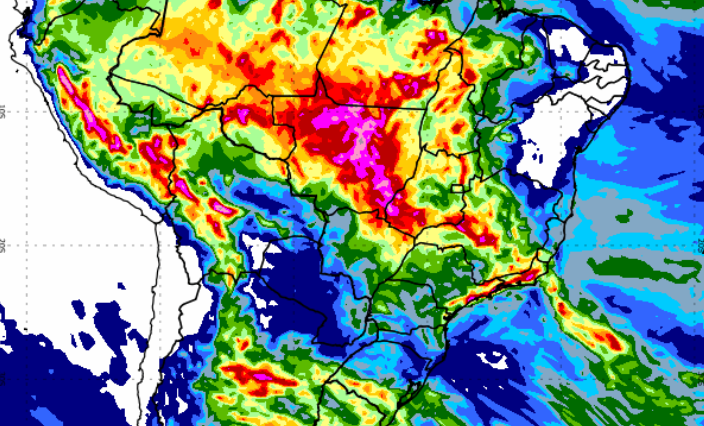
The 2025/2026 cycle was marked by variations in rainfall distribution throughout the months. In January, much of the state recorded rainfall below the historical average, with accumulations between 30 and 120 millimeters. Of the 63 monitored weather stations, 59 showed volumes below average.
The regularization of rainfall occurred from February onwards, when a large part of the state recorded rainfall above the climatological average. In March, volumes remained high in areas of the central, northern and western regions. The conditions favored the progress of sowing, which reached 91.6% of the planned area by the end of that month.
Planting was completed on May 1st, about a week later than the previous cycle. Approximately 70% of the sowing took place between the second week of February and the second week of March.
In May, heavy rains in some regions delayed the start of the harvest, while localized hailstorms affected crops in municipalities such as Deodápolis, Fátima do Sul, Glória de Dourados, Itaporã, Ivinhema, and Dourados. The survey estimated that approximately 2,850 hectares were affected by these events.
In late June, frosts recorded in the southern border region caused damage to crops in the R3 and R4 reproductive stages, although an estimate of the affected area has not yet been consolidated.
Starting in July, the predominance of periods with lower rainfall favored the progress of harvesting operations. The work was completed on October 9, 2026, approximately two weeks after the end of the previous harvest season.